
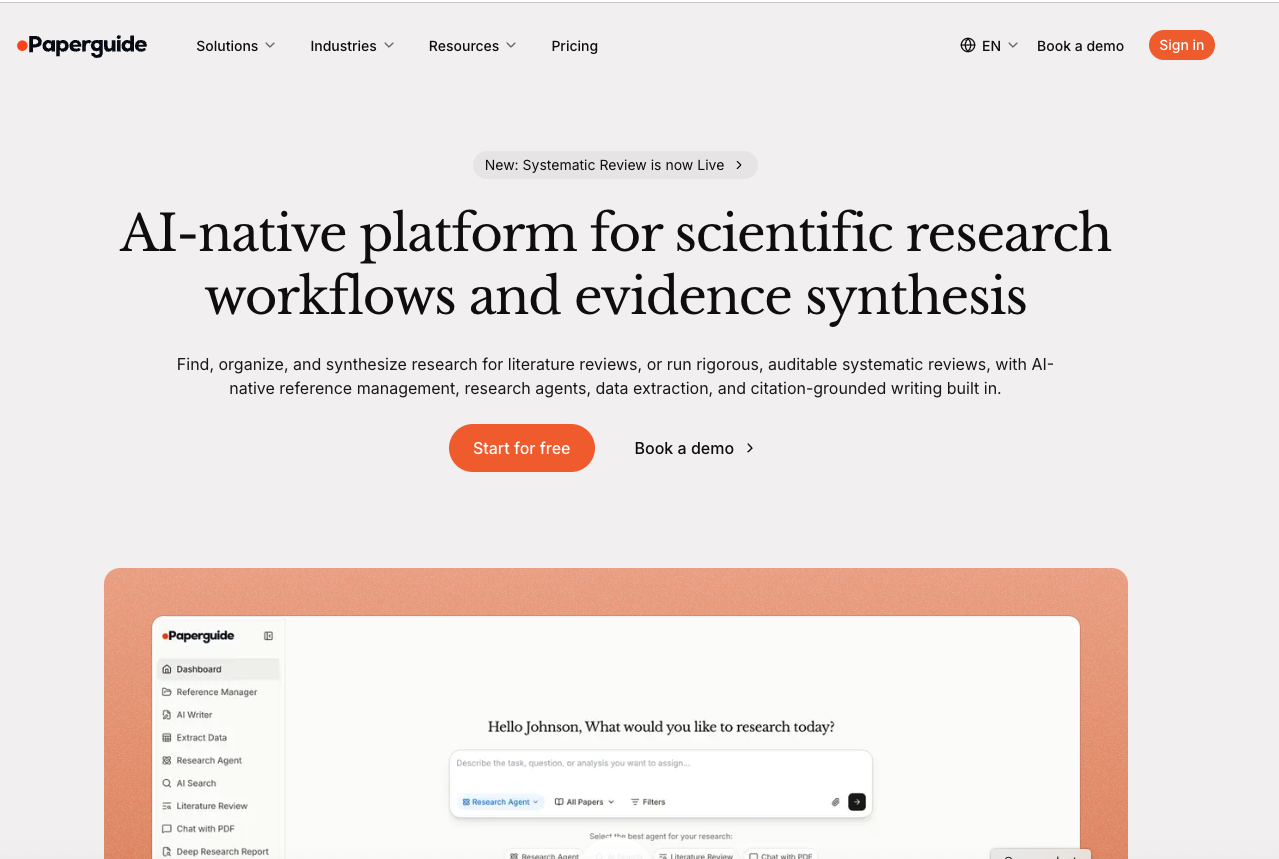
Research papers, references, citations, systematic reviews and evidence synthesis can quickly become difficult to manage, especially when a project involves hundreds of academic papers. Paperguide AI aims to simplify this process by bringing research discovery, reference management, paper analysis, data extraction and academic writing into one platform.
Instead of switching between several research tools, users can use Paperguide to find relevant studies, organize papers, ask questions about their research library and create citation-grounded content.
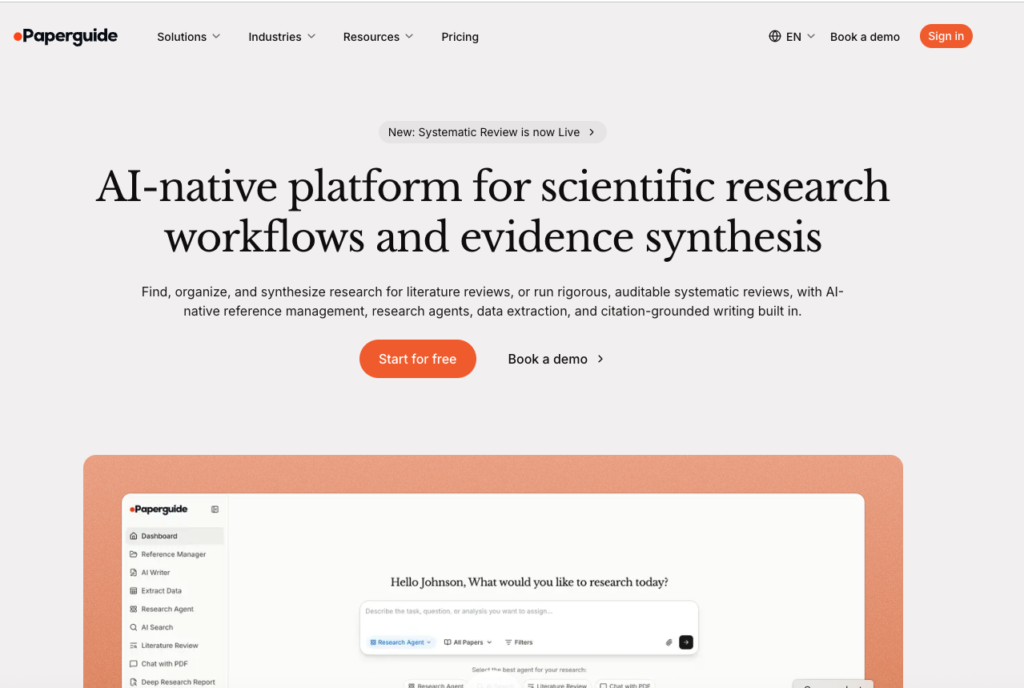
Quick Introduction to Paperguide AI
Paperguide is an AI-native platform designed for scientific research workflows, literature reviews, systematic reviews and evidence synthesis.
Its main focus is not simply generating text with AI. The platform is built around research evidence, citations and traceability. This makes it particularly useful for researchers, students, academics, research institutions and teams working with evidence-heavy projects.
Paperguide combines an AI reference manager, research agents, literature search, data extraction and citation-grounded writing in one workspace.
The platform can also support structured systematic reviews where researchers need to document search methods, screening decisions, extracted information and final evidence.
What Does Paperguide AI Do?
Paperguide is designed to help researchers manage different stages of the research process.
A typical workflow can include:
- Finding relevant research papers
- Organizing papers in an AI-powered library
- Importing references from Zotero or Mendeley
- Adding papers through DOI
- Reading and annotating research papers
- Asking questions about saved papers
- Extracting information from research papers
- Supporting literature reviews
- Conducting systematic reviews
- Creating evidence-based reports
- Writing with citations connected to research sources
The idea is fairly straightforward: instead of keeping research scattered across different applications, Paperguide brings much of the workflow together.
Key Features of Paperguide AI
1. AI-Native Reference Manager
Paperguide includes a reference management system where researchers can collect and organize academic papers.
Papers can be imported from tools such as Zotero and Mendeley, or added using a DOI. The platform can also fetch metadata and available open-access PDFs.
Notes and annotations can stay connected to individual papers, making it easier to return to important information later.
2. AI Research Agent
The Research Agent allows users to ask questions about papers stored in their research library.
Instead of manually opening multiple papers to find an answer, researchers can ask questions and receive answers grounded in their saved sources.
This citation-focused approach can make it easier to trace where information came from.
3. AI Literature Review
Literature reviews often involve reading a large number of papers, comparing findings and identifying patterns.
Paperguide is designed to help researchers organize this work and synthesize information from relevant studies.
It can be useful for students working on dissertations and theses, as well as researchers preparing academic papers or research reports.
4. Systematic Review Support
One of the major features of Paperguide is its focus on systematic reviews.
The platform supports workflows involving predefined protocols, documented searches, screening decisions, evidence extraction and PRISMA reporting.
Its Dual Review Systematic Review workflow allows two reviewers to screen independently, while a conflict resolver can help handle disagreements.
Importantly, the platform positions AI as a preparation and evidence-support layer rather than the final decision-maker. Human reviewers remain responsible for final screening decisions.
5. Evidence for Screening Criteria
Systematic review screening can be time-consuming because reviewers need to determine whether individual papers meet specific criteria.
Paperguide can pull relevant statements from abstracts or full-text papers and connect those statements to screening criteria.
This gives reviewers cited evidence behind a screening decision rather than forcing them to reread an entire paper every time.
6. Data Extraction
Another useful feature is structured data extraction.
Researchers can extract values from papers and organize them into tables. Each extracted value can be connected to the statement or evidence it came from.
That traceability can be particularly useful when researchers need to verify information before moving toward synthesis.
7. PRISMA Reporting
For systematic reviews, documentation matters almost as much as the final findings.
Paperguide can generate a PRISMA diagram based on the actual review counts and produce a final set of verified tables and synthesized reporting.
This can help researchers maintain a clearer record of how papers moved through the review process.
8. Citation-Grounded Academic Writing
Paperguide also includes AI writing capabilities designed around research sources.
Rather than treating AI-generated text as a standalone output, the platform connects writing with citations and research evidence.
This can be useful when preparing literature reviews, research summaries, academic papers and other evidence-based documents.
Uses of Paperguide AI
Paperguide can be useful in several research-related situations.
For Students
Students working on dissertations, theses, assignments and research projects can use the platform to organize papers, summarize research and manage citations.
For Academic Researchers
Researchers can use Paperguide to manage literature collections, analyze studies and support systematic review workflows.
For Research Institutions
Research teams dealing with large collections of scientific literature can use a shared research workflow instead of relying on several disconnected tools.
For Pharma and Life Sciences
Evidence synthesis is important in pharmaceutical and life-science research. Structured extraction, source verification and systematic reviews can help teams manage evidence-heavy projects.
For Medical Device and Diagnostics Research
The platform also targets medical device and diagnostics workflows, where research evidence and traceability can be especially important.
For Policy and Evidence Research
Government and policy teams often need to review large amounts of published research before making decisions. Tools that help organize and synthesize evidence can make this process more manageable.
Paperguide AI: Pros and Cons
Pros
- Combines several research workflows in one platform
- AI-powered reference management
- Supports literature reviews and systematic reviews
- Citation-grounded answers and writing
- Evidence can be linked to screening decisions
- Supports structured data extraction
- PRISMA reporting is built into the systematic review workflow
- Can import references from Zotero and Mendeley
- Useful for researchers working with large paper collections
Cons
- It is primarily designed for research-heavy workflows, so casual users may not need all its features
- AI outputs still need human verification
- Systematic reviews require methodological knowledge even when software is used
- Advanced research workflows may take some time to learn
- Users looking only for a simple citation manager may find the broader platform more than they need
Paperguide AI Pricing and Overview
Paperguide offers a range of AI-powered research tools, but pricing can depend on the specific plan and features available at the time of use.
Because AI research platforms frequently change their usage limits, credits and subscription structures, users should check the official Paperguide pricing page before choosing a plan.
For someone who only needs occasional paper summaries or citation help, a basic option may be sufficient. Researchers conducting larger literature reviews or systematic reviews may benefit more from features built for structured research workflows.
Paperguide AI vs Traditional Research Tools
Traditional research workflows often involve using separate platforms for searching papers, managing references, reading PDFs, extracting data and writing.
For example, a researcher might discover papers through one service, organize them in Zotero or Mendeley, read PDFs separately, extract information into spreadsheets and finally move everything into a word processor.
Paperguide takes a different approach by connecting these steps.
The biggest advantage is therefore not just one individual AI feature. It is the attempt to create a single research workspace where discovery, organization, analysis and writing are connected.
Who Should Use Paperguide AI?
Paperguide can be a good fit for:
- PhD and postgraduate students
- Academic researchers
- Systematic review teams
- Research institutions
- Medical and healthcare researchers
- Pharma and life-science teams
- Evidence synthesis professionals
- Researchers handling large literature collections
For someone writing a simple college assignment with only a few sources, the platform may be more powerful than necessary.
Final Verdict
Paperguide AI is built for a problem that many researchers know well: research can become messy when papers, notes, citations, extracted data and writing are spread across different tools.
By combining reference management, AI research agents, literature reviews, systematic review workflows, evidence extraction and citation-grounded writing, Paperguide attempts to bring the complete research process into one place.
Its strongest appeal is likely to researchers who work with large volumes of scientific literature and need their findings to remain connected to the original evidence.
AI can make research faster, but accuracy and methodology still depend on human judgment. Paperguide follows that principle by keeping evidence and verification at the center of its workflow.
For researchers looking for an AI-powered research assistant that goes beyond simple paper summarization, Paperguide is worth exploring.