


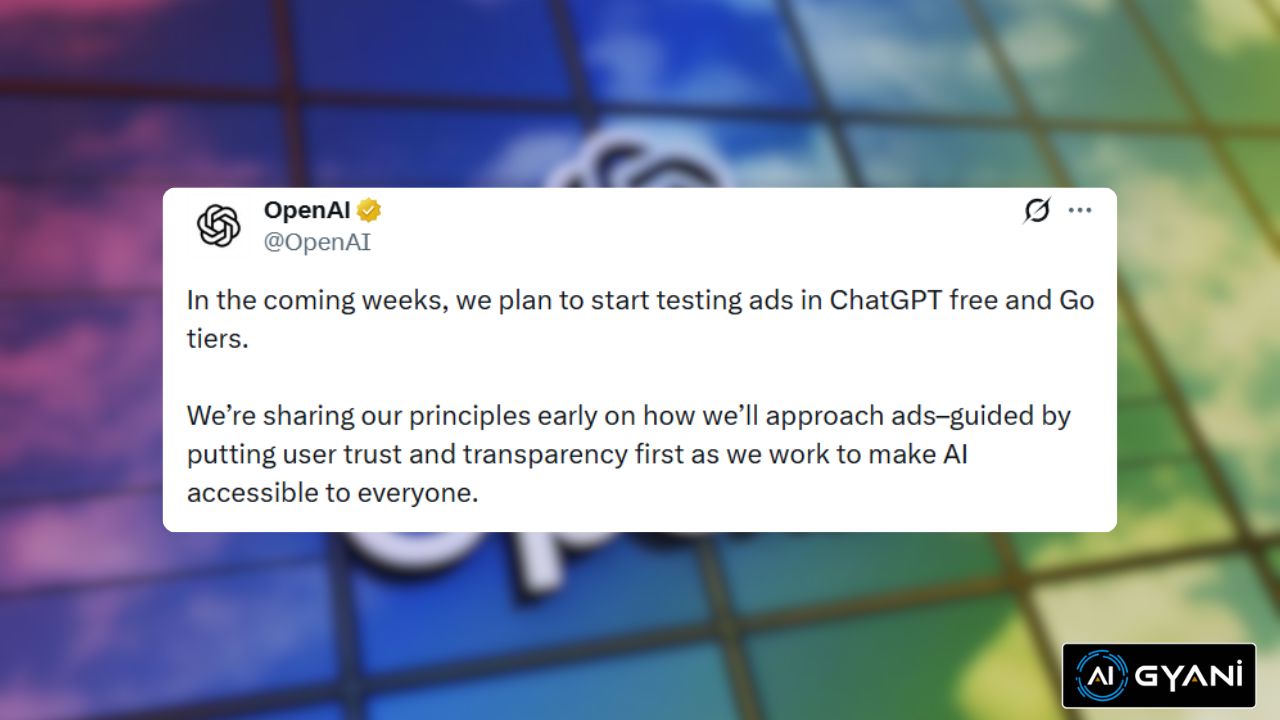
OpenAI has announced that it will begin testing advertisements in ChatGPT, marking a major shift in how one of the world’s most popular AI products is monetized.
The move, revealed on January 16 through an official post on X (formerly Twitter), reflects the growing financial pressures of operating large-scale AI systems, while also igniting widespread debate across the tech community.
The company said ads will initially appear in the free version of ChatGPT and the newly launched “Go” tier, as OpenAI looks to balance broader accessibility with sustainable revenue generation.
Ads Coming to Free and Go Plans
According to OpenAI, the ad rollout will begin in the United States over the coming weeks and will be limited to logged-in adult users.
The newly introduced Go plan, priced at $8 per month and available globally, offers features such as messaging, image generation, file uploads, and memory retention. It is positioned as a lower-cost alternative to the $20-per-month Plus plan.
Higher-tier subscriptions — including Plus, Pro ($200 per month), Business, and Enterprise — will remain completely ad-free.
In its announcement, OpenAI emphasized that advertising is intended to support its mission of making AI tools accessible to everyone. The company stated that ads would help offset the significant costs of AI development without relying solely on subscriptions.
“We’re sharing our principles early on for how we’ll approach ads, guided by putting user trust and transparency first,” OpenAI said in its post.
OpenAI’s Ad Principles
To address concerns around commercialization and user trust, OpenAI published a set of “Ad Principles” outlining how advertising will function within ChatGPT. Key commitments include:
- Answer Independence: Ads will not influence ChatGPT’s responses, which remain optimized solely for user helpfulness.
- Clear Separation: Sponsored content will be clearly labeled and kept separate from AI-generated answers.
- Conversation Privacy: User chats will not be shared with advertisers, and personal data will not be sold.
- User Control: Personalization can be turned off, ad-related data can be cleared, and users can opt for ad-free paid plans.
- Long-Term Trust: OpenAI says it will prioritize user experience and trust over maximizing revenue or engagement.
The company described ChatGPT as a “trusted and personal space,” saying ads would be designed to preserve that experience.
How Ads Will Appear
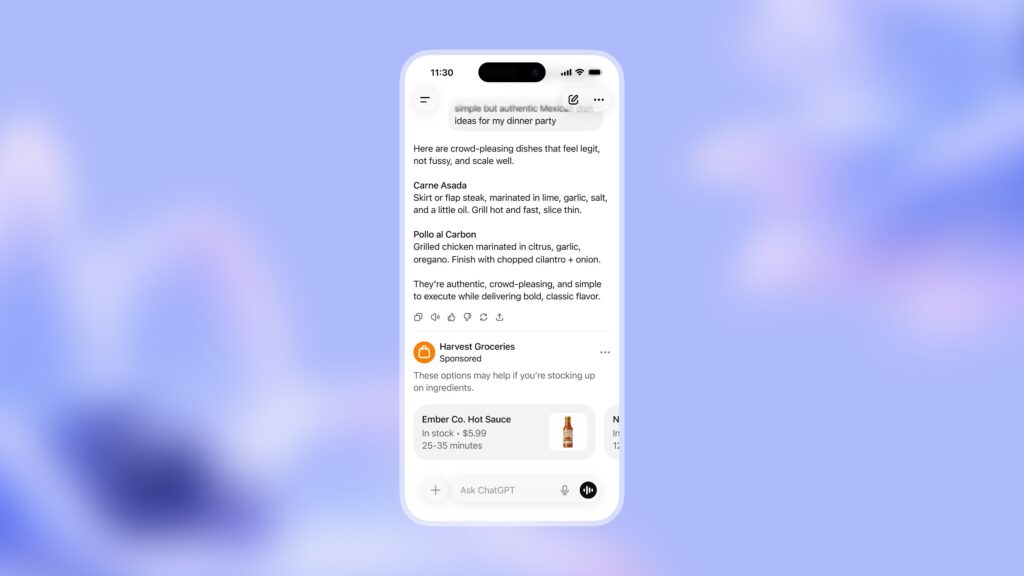
Visual examples shared by OpenAI show ads appearing below regular ChatGPT responses in a clearly marked “Sponsored” section.
For instance, after answering a question about hosting a Mexican dinner party, ChatGPT may display a sponsored grocery product relevant to the topic.
Ads will not appear in conversations involving sensitive topics such as health, mental health, or politics. Users under 18 will not see ads, and personalization is enabled by default but can be disabled.
OpenAI also hinted that ads could eventually become more conversational, allowing users to ask questions directly about promoted products.
Mixed Reactions From the Tech Community
The announcement quickly gained traction on X, generating millions of views and thousands of reactions. While some users described the move as a practical necessity, many criticized it as a step backward.
Several commenters compared OpenAI’s decision unfavorably with competitors like Anthropic, which has recently focused on advanced coding and automation tools. Others expressed fears that ads could undermine trust, even with safeguards in place.
Memes and satirical posts dominated much of the reaction, with users joking about inappropriate ad placements and mocking the idea of “ad-supported AI.” Privacy advocates also raised concerns about subtle influence and long-term data use, despite OpenAI’s assurances.
However, not all feedback was negative. Some users argued that ads are preferable to eliminating the free tier entirely, noting that the format appears unobtrusive and limited to lower-cost plans.
What This Means for the AI Industry
With more than 200 million weekly users and billions spent annually on computing resources, OpenAI is under increasing pressure to monetize its services.
Analysts suggest that advertising could eventually become a significant revenue stream, similar to search engines, but warn that it may also push users toward competitors offering cleaner, ad-free experiences.
As OpenAI begins testing and refining its ad strategy, the broader AI industry will be watching closely. For users in India and other markets, the change could bring expanded access at a lower cost — but with occasional sponsored content woven into the experience.
Whether ads strengthen ChatGPT’s sustainability or weaken its reputation as a neutral AI assistant remains an open question. What is clear is that the AI boom is rapidly moving from experimentation into a fully commercial phase.