




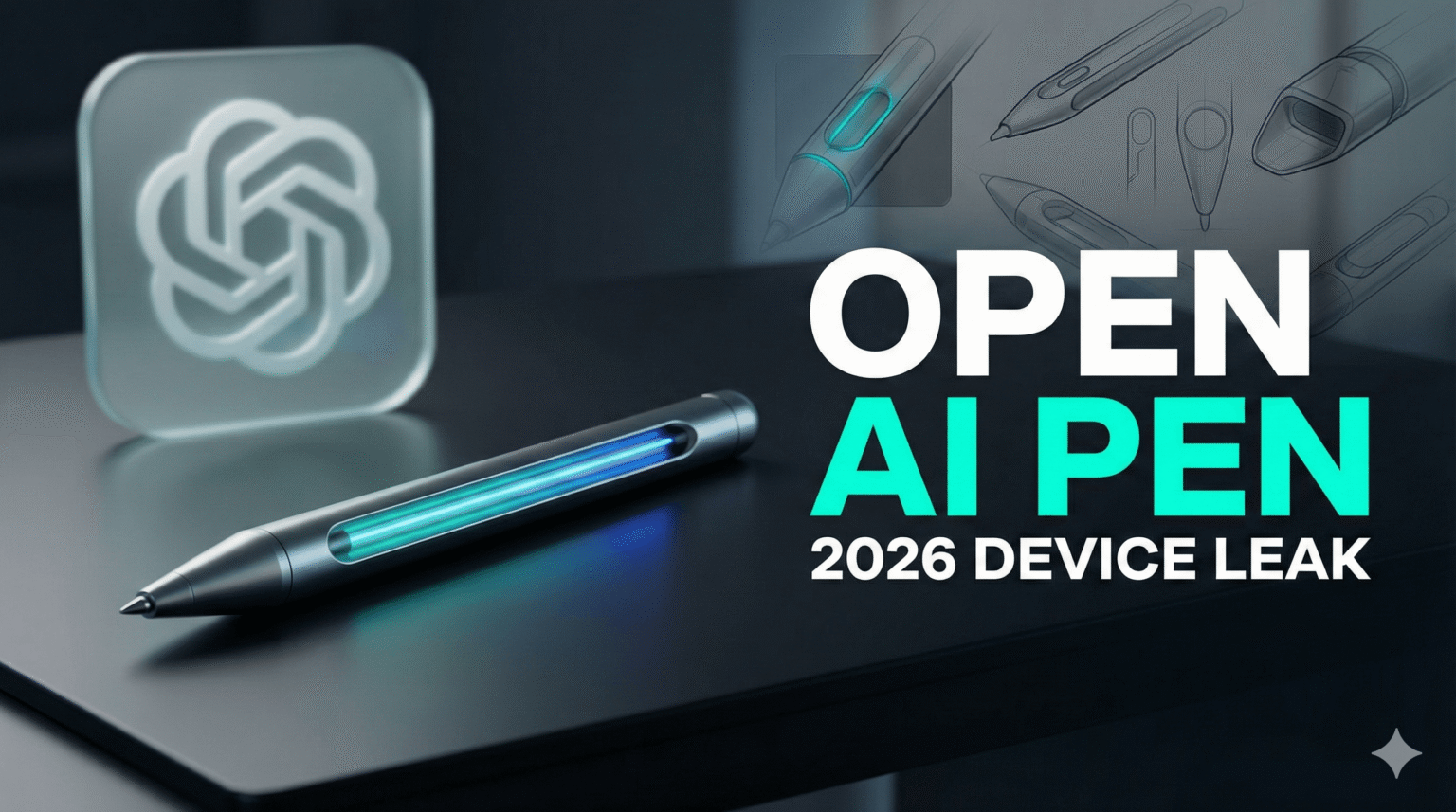
OpenAI’s first serious consumer hardware push is reportedly a pen‑style AI gadget now widely dubbed the open ai pen.
Codenamed “Gumdrop”, this Jony Ive–designed device aims to blend natural writing and speech with ChatGPT, positioning the open ai pen as a calm, screen‑light alternative to smartphones.
What is the Open AI Pen?
The open ai pen is described in leaks as a compact, pen‑like or clip‑on device designed to capture handwriting and voice, then send that data to ChatGPT for processing.
Reports suggest the open ai pen could transcribe handwritten notes into editable text, summarize content, answer questions, and reorganize ideas using OpenAI’s models.
Unlike phones, the open ai pen is expected to emphasize minimalism, with no traditional display and a focus on ambient, distraction‑free interactions.
Manufacturing shift: why Foxconn, why Vietnam?
Early leaks indicated that the open ai pen (Gumdrop) was initially aligned with Chinese manufacturer Luxshare, a major Apple supplier.
A reported dispute over location and a desire to avoid China for this flagship device have pushed OpenAI toward Foxconn instead, reshaping the open ai pen supply chain.
Current reports say Foxconn will likely build the open ai pen in Vietnam, with some potential capacity in its U.S. plants in Wisconsin, Ohio, Texas, Virginia, or Indiana.
This positions the open ai pen inside the broader “China‑plus‑one” manufacturing trend sweeping the tech industry.
Design vision: Jony Ive’s role in the Open AI Pen
The open ai pen is the first major product of OpenAI’s deep partnership with legendary Apple designer Jony Ive.
After OpenAI acquired Ive‑linked hardware startup io in a multibillion‑dollar deal, Ive and a core team of hardware engineers began leading the design language for the open ai pen and related devices.
Leaked descriptions suggest the open ai pen will be “elegantly simple” and “playful,” with Ive aiming to make the device feel like a familiar object rather than a sci‑fi gadget.
The open ai pen is also framed as a possible “third core device” that complements laptops and smartphones instead of replacing them.
Expected features and use cases
Early reports outline several possible capabilities for the open ai pen:
- Real‑time handwriting recognition that turns notebook scribbles into digital text synced to ChatGPT.
- Built‑in microphones so the open ai pen can capture voice notes, meetings or interviews and generate summaries or action points.
- Deep integration with ChatGPT to rewrite, translate, outline or expand ideas captured by the open ai pen.
- Bluetooth connectivity so the open ai pen can sync with phones or laptops while still feeling like a standalone companion.
These features position the open ai pen as a natural fit for students, creators, knowledge workers, and journalists who already rely on notebooks but want AI superpowers on top.
Launch timeline and strategic stakes
Most leaks put the open ai pen on track for a 2026–2027 launch window, aligning with OpenAI’s next‑generation audio and multimodal models. Executives, including Sam Altman, have publicly teased a calmer, screenless AI device that sounds very much like the open ai pen concept.
If the open ai pen delivers low‑latency voice, reliable transcription, and useful daily workflows, it could avoid the fate of earlier AI gadgets like Humane AI Pin and Rabbit R1, which struggled to prove real‑world value.
For now, the open ai pen remains unannounced—but in the AI hardware race, all eyes are on Gumdrop.