

Experiential Labs AI
Experiential Labs is an open-source AI gateway that gives teams one API for accessing multiple AI models, provider keys, and self-hosted models while providing usage controls, routing, caching, and model optimization.
Visit website ↗Screenshots
1 image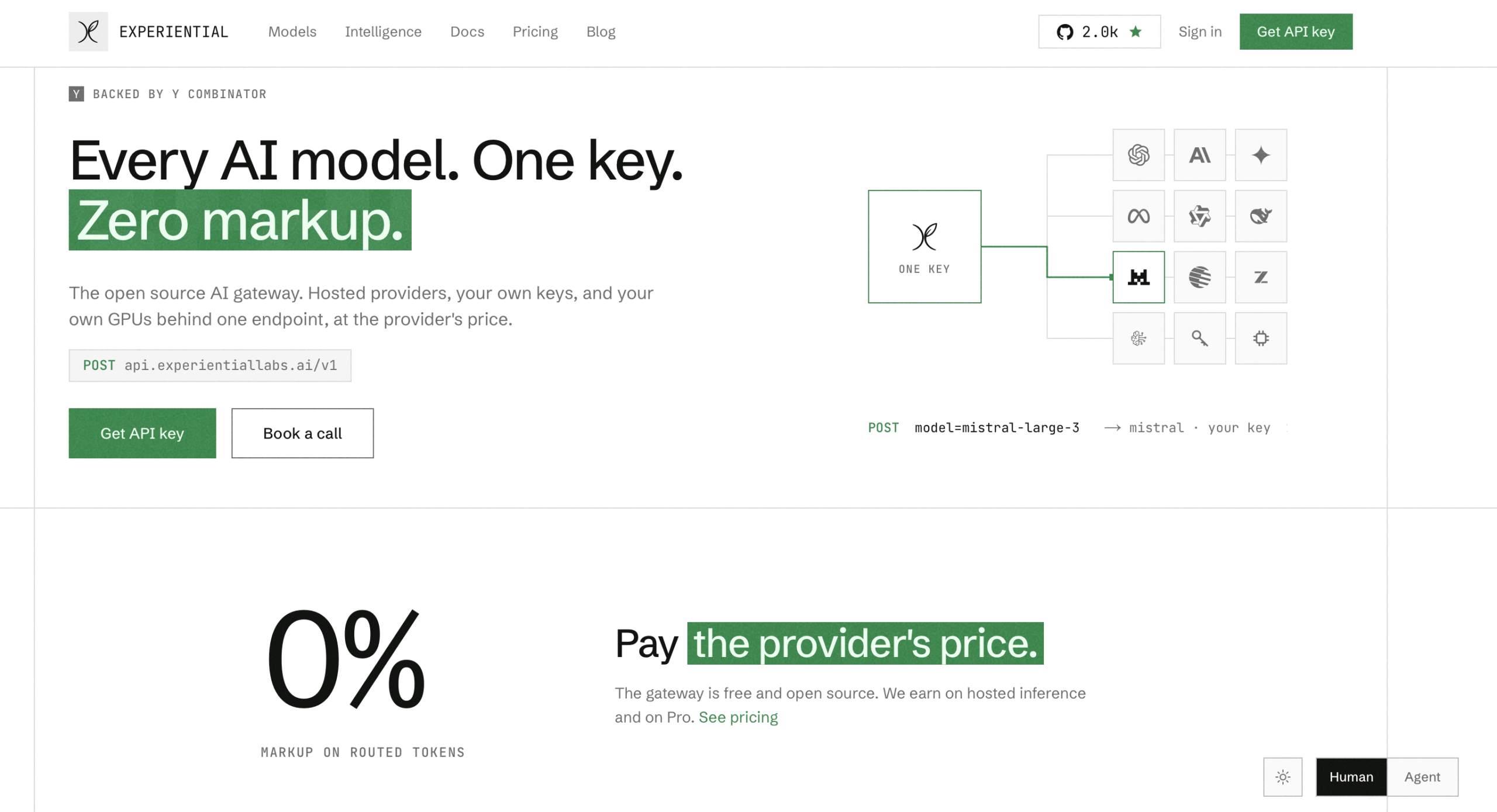
What is Experiential Labs AI?
Experiential Labs is an open-source AI infrastructure platform designed to give developers and organizations a single control plane for their AI model usage. Instead of integrating separately with OpenAI, Anthropic, Google, Meta, Qwen, Mistral and other providers, teams can route their requests through one OpenAI-compatible endpoint.
The platform supports both hosted model providers and customer-owned infrastructure. Teams can bring their own provider keys, connect local or cloud GPUs, or use hosted inference, while keeping applications pointed at the same gateway. Experiential says the gateway applies zero markup to routed provider tokens, with customers paying the underlying provider price.
Experiential Labs goes beyond being a simple API gateway. Its intelligence layer analyzes model traffic to identify opportunities for model switching, caching, batching and eventually training specialized models on a company’s own workloads. The goal is to reduce AI costs and latency while maintaining or improving task quality.
The platform is particularly aimed at AI engineering teams, startups and companies running multiple agents or models in production. It provides centralized API keys, spending limits, model allowlists, usage attribution and request logs, while the gateway itself can be self-hosted.
Key features
- Unified AI Gateway: Developers can access models from multiple providers through a single OpenAI-compatible API endpoint.
- Multi-provider Routing: Teams can route requests across providers such as OpenAI, Anthropic, Gemini, Qwen, Mistral and others without changing application integrations.
- BYOK and Self-hosting: Organizations can bring their own provider keys or run models on their own infrastructure while keeping them behind the same gateway.
- AI Cost Optimization: Experiential analyzes traffic and recommends model switches, caching and other changes that can reduce inference costs.
- Usage and Spend Controls: Administrators can create scoped API keys, spending caps, model allowlists and local-only permissions.
- Custom Model Training: The platform can use workload traces and evaluations to train smaller specialized models for repeatable company tasks.
- Open Source: The core gateway is open source and written in Rust, allowing organizations to deploy it on their own infrastructure.
How you can use it
Managing multiple LLM providers: Development teams can integrate one API instead of maintaining separate integrations for every model provider. This is particularly useful for AI applications that use different models for reasoning, coding, classification, extraction, or high-volume workloads.
Reducing AI infrastructure costs: Teams can analyze their existing model traffic and identify requests that could use a cheaper or faster model without sacrificing the required quality. Experiential also identifies caching opportunities and can provide optimization recommendations based on actual workloads.
Running production AI agents: Companies operating multiple agents can use separate keys, spending limits, model permissions and usage attribution for each agent, team or employee. This provides centralized control over AI consumption and makes it easier to understand where model spending is going.
Training specialized models: For repetitive workflows, companies can use their production traces and evaluations to train smaller models specifically for their workloads. Experiential positions this as a way to replace expensive frontier-model calls with faster, lower-cost specialized inference while retaining a frontier model as fallback.
Plans & pricing
The Experiential gateway itself is free and open source, with zero markup on routed tokens. When using external providers, customers pay the provider's price rather than an additional per-token markup from Experiential.
Experiential also offers hosted inference and Pro/Enterprise offerings, but a simple public starting subscription price is not clearly displayed on the current main pricing information. For directory purposes, "Not confirmed" is safer than assigning a monthly price.
The company is also currently offering a startup program with $500 in usage credits, including $20 immediately upon sign-in and the remainder after application review. The program also advertises matched OpenAI spend up to $50,000 for qualifying startups.
The strengths & trade-offs
Pros
- Open-source AI gateway.
- One API for multiple model providers.
- Zero markup on routed provider tokens.
- Supports BYOK, hosted models and self-hosted infrastructure.
- Strong spending, access and usage controls.
- Built-in model optimization and caching intelligence.
- Supports specialized model training.
- OpenAI-compatible API makes integration relatively straightforward.
Cons
- Primarily designed for developers and organizations rather than non-technical users.
- The product is more infrastructure-oriented than a ready-to-use AI application.
- Hosted inference and enterprise pricing are not transparently presented as a simple public tier.
- Model optimization benefits depend on having sufficient production traffic and useful telemetry.
- Self-hosting introduces additional infrastructure and operational requirements.
Alternatives

Frequently asked questions
What is Experiential Labs?
Experiential Labs is an open-source AI gateway and infrastructure platform for routing, managing and optimizing access to multiple AI models.
What does Experiential Labs do?
It provides a single API through which developers can access hosted models, their own provider keys, local models and custom models.
Is Experiential Labs free?
The open-source gateway is free and has zero token markup, while hosted inference and Pro/Enterprise services can involve usage charges.
Does Experiential Labs support OpenAI-compatible APIs?
Yes. Its gateway exposes an OpenAI-compatible API endpoint, allowing existing clients to be pointed at the gateway with a base-URL change.
Which AI models does Experiential Labs support?
The platform lists models and providers including OpenAI, Anthropic, Gemini, Meta, Qwen, GLM, Kimi, DeepSeek and Mistral, alongside customer APIs and local models.
Can Experiential Labs be self-hosted?
Yes. The gateway is open source and can be deployed on an organization's own infrastructure.
Does Experiential Labs add a markup to model costs?
The gateway states that it charges zero markup on routed tokens and customers pay the provider's price.
Can Experiential Labs reduce LLM costs?
It is designed to identify cost-saving opportunities through model switching, caching and specialized-model training, although actual savings depend on the workload.
Does Experiential Labs provide an API?
Yes. The platform provides an OpenAI-compatible API endpoint for routing model requests.
Is Experiential Labs open source?
Yes. The core AI gateway is open source and available publicly on GitHub.