
In the rapidly evolving landscape of artificial intelligence, Perplexity AI has once again pushed boundaries with its latest innovation.
As someone who’s followed the AI space closely, I was intrigued by the buzz around the “Perplexity Computer.”
This isn’t your typical hardware launch—it’s a bold step into unified AI systems. Let’s dive into a comprehensive review, covering everything from its core concept to whether it’s a smart investment for you.
Launch Context: A Silent Build-Up to a Game-Changer
Perplexity Computer was unveiled on February 25, 2026, by Perplexity AI’s CEO Aravind Srinivas via a high-profile X post, accompanied by a demo video showcasing its capabilities.
The announcement came after months of quiet development, positioning it as the “next big thing” in AI orchestration. Unlike flashy hardware reveals, this launch emphasized software evolution, drawing parallels to historical computing shifts—like the Macintosh’s “hello” interface.
It builds on Perplexity’s recent advancements, including an upgraded Deep Research tool that outperformed OpenAI and Anthropic in benchmarks, and features like Model Council for multi-model comparisons.
The timing aligns with intensifying AI agent wars, following acquisitions like OpenAI’s OpenClaw and Anthropic’s CoWork enhancements.
What is the Perplexity Computer?
At its core, Perplexity Computer is not a physical device but a general-purpose digital worker—a unified AI system that integrates every current AI capability into one cohesive platform.
It transcends traditional chat interfaces (which provide answers) and basic agents (which handle tasks) by creating and executing entire workflows that can run asynchronously for hours or even months.
Think of it as an AI orchestrator that operates like a human co-worker, managing files, tools, memory, and models to deliver end-to-end project outcomes. It’s embedded within Perplexity’s ecosystem, accessible via browser or apps, and represents a shift where AI becomes “the computer” itself.
Perplexity Computer Features
Perplexity Computer shines in its ability to break down complex goals into tasks and subtasks, spawning sub-agents for execution. Here’s a breakdown:
- Intelligent Task Decomposition: Describe an outcome, and it automatically plans and delegates—e.g., researching data while drafting documents or processing APIs.
- Parallel and Asynchronous Execution: Run dozens of sub-agents simultaneously without constant oversight.
- Problem-Solving Autonomy: If stuck, it creates sub-agents to resolve issues, like finding API keys or coding solutions, only checking in with you when necessary.
- Isolated Environments: Each task operates in a secure, real filesystem with browser access and tool integrations.
- Persistent Memory and Context: Retains files, context, and progress across sessions, picking up where you left off.
- App Connectivity: Integrates with thousands of apps for seamless workflows, like monitoring stocks or generating visuals.
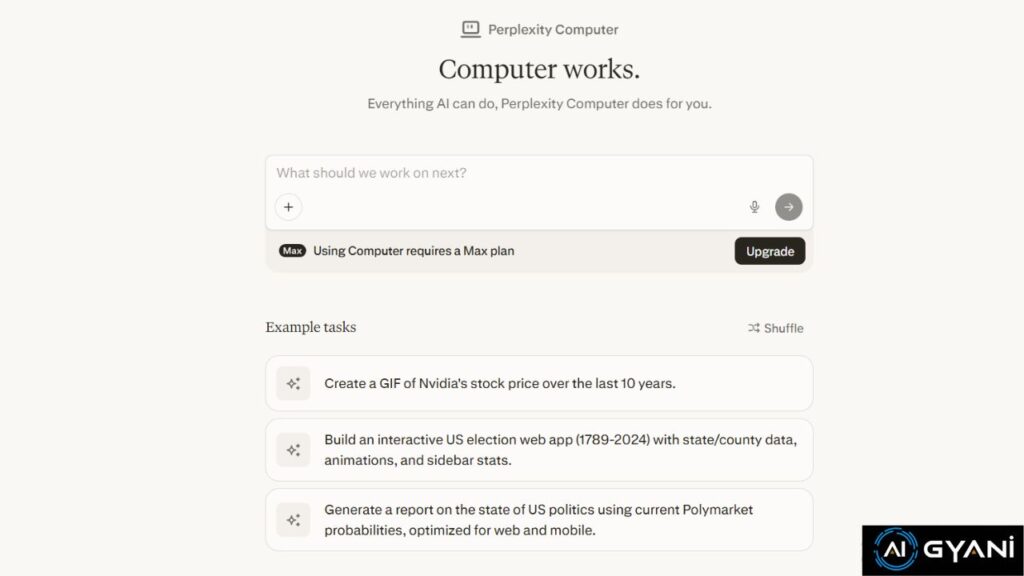
The interface is intuitive, with a simple “Ask Computer” prompt leading to dynamic sub-agent dashboards, as seen in demo footage showing real-time stock analysis and report generation.
AI Capabilities: Multi-Model Mastery
What sets Perplexity Computer apart is its intelligent multi-model orchestration. It uses Opus 4.6 as the core reasoning engine to route tasks to specialized models:
| Model | Specialty | Use in Perplexity Computer |
|---|---|---|
| Opus 4.6 | Core Reasoning & Orchestration | Routes tasks and oversees workflows |
| Gemini | Deep Research | Handles in-depth information gathering |
| Nano Banana | Image Generation | Creates visuals and graphics |
| Veo 3.1 | Video Generation | Produces dynamic media content |
| Grok | Speed for Lightweight Tasks | Quick computations and simple queries |
| ChatGPT 5.2 | Long-Context Recall & Search | Manages extensive data and wide searches |
This model-agnostic approach allows users to select or switch models per subtask, with controls for token budgets and spending caps. It leverages Perplexity’s strengths in real-time search, reducing hallucinations compared to standalone models like ChatGPT.
Hardware/Software Specs: Software-Centric Powerhouse
As a cloud-based software system, there are no traditional hardware specs. Instead, it runs on Perplexity’s infrastructure:
- Core Engine: Opus 4.6 with 19 integrated models.
- Compute Environments: Isolated sandboxes with real filesystems, browsers, and API access.
- Platforms: Web, iOS, Android, Mac, Windows (via Perplexity apps).
- Limitations: Workflow duration up to months; supports parallel sub-agents but capped by subscription usage.
It’s designed for accessibility—no local setup required, making it universally deployable.
How It Compares to Competitors
Perplexity Computer positions itself as an evolution beyond competitors:
- Vs. ChatGPT (OpenAI): While ChatGPT excels in conversational AI, Perplexity adds real-time search and multi-model orchestration, reducing errors and enabling end-to-end execution. Deep Research beats ChatGPT in benchmarks.
- Vs. Claude CoWork (Anthropic): Similar in workflow management, but Perplexity’s 19-model system and persistent memory offer broader capabilities. Users note it’s more “newbie-friendly.”
- Vs. OpenClaw (OpenAI-acquired): OpenClaw focuses on open-source agents; Perplexity integrates it-like features with proprietary orchestration, adding security and app connectivity.
- Overall Edge: Shifts focus from single-model benchmarks to system-level efficiency, outpacing tools like Gemini or DeepSeek in integrated workflows.
Pricing: Premium Access for Power Users
Available exclusively to Perplexity Max subscribers at $200 per month (or $2000 annually). This includes unlimited Pro searches, advanced models, and now Computer access. Usage is metered with customizable spending caps to prevent overages. Compared to OpenAI’s $200/month Pro plan (capped at 100 queries), Perplexity offers more flexibility—up to 500 Pro searches monthly. Free tiers get limited access to basic features, but Computer is Max-only.
Target Users: Professionals and Innovators
Ideal for researchers, developers, analysts, and business professionals needing autonomous project management.
It’s perfect for those handling complex, multi-step tasks—like entrepreneurs building apps or teams monitoring markets. Casual users might find it overkill, but it’s a boon for AI enthusiasts or enterprises seeking efficiency.
Strengths: Efficiency and Innovation
- Unmatched orchestration of 19 models for specialized tasks.
- Asynchronous workflows free up user time.
- High accuracy with real-time search and citations.
- Secure, isolated environments minimize risks.
- Adaptable to future model advancements.
Weaknesses: Cost and Dependencies
- Steep $200/month price may deter individuals; potential high usage costs for intensive workflows.
- Relies on cloud connectivity—no fully local option yet.
- Occasional need for user check-ins in ultra-complex scenarios.
- Security concerns around data access and new attack surfaces.
Real-World Use Cases: From Research to Deployment
- Financial Analysis: Research stock trends, generate reports, and deploy interactive dashboards (e.g., NVIDIA earnings visualization).
- Content Creation: Design graphics, code websites, and manage deployments end-to-end.
- Monitoring and Alerts: Set up competitive monitoring for news or market changes, with notifications.
- Long-Term Projects: Run ongoing workflows like data processing or app maintenance over months.
- Creative Work: Generate images/videos while researching topics, all in one system.
Users report it’s transformative for closing to-do lists autonomously.
Recent Tweets and Social Media Reactions
The launch sparked excitement on X, with over 5,700 likes on the announcement post. Reactions highlight its agent-like power: “This is the kind of infrastructure that makes individual model comparisons look small,” noted one user.
Others compared it to OpenClaw with enhanced security, questioning costs: “A month of computing would cost $1500!” Positive vibes dominate, with calls for trials and praise for its “nuclear” impact on AI wars.
Expert Reactions: Praise with Cautious Optimism
Experts laud its unification of AI tools: Perplexity’s data scientist Alexis Weill called it “one of our most exciting launches,” emphasizing its power for search, build, and analysis.
Reviews echo PCMag’s take on Perplexity’s core—strong search but evolving research depth—now amplified. TechCrunch notes its browser integration via Comet, broadening beyond search. Some, like Reddit users, question value at $200/month but appreciate reduced hallucinations.
Is It Worth Buying? A Resounding Yes for the Right User
If you’re a power user drowning in multi-tool workflows, Perplexity Computer is worth the $200/month splurge—it’s a productivity multiplier that could save hours weekly.
For casual queries, stick to free tiers or competitors. As AI advances, this could become indispensable, but start with a trial if available. In 2026’s AI race, it’s a frontrunner for those ready to embrace the future of work.