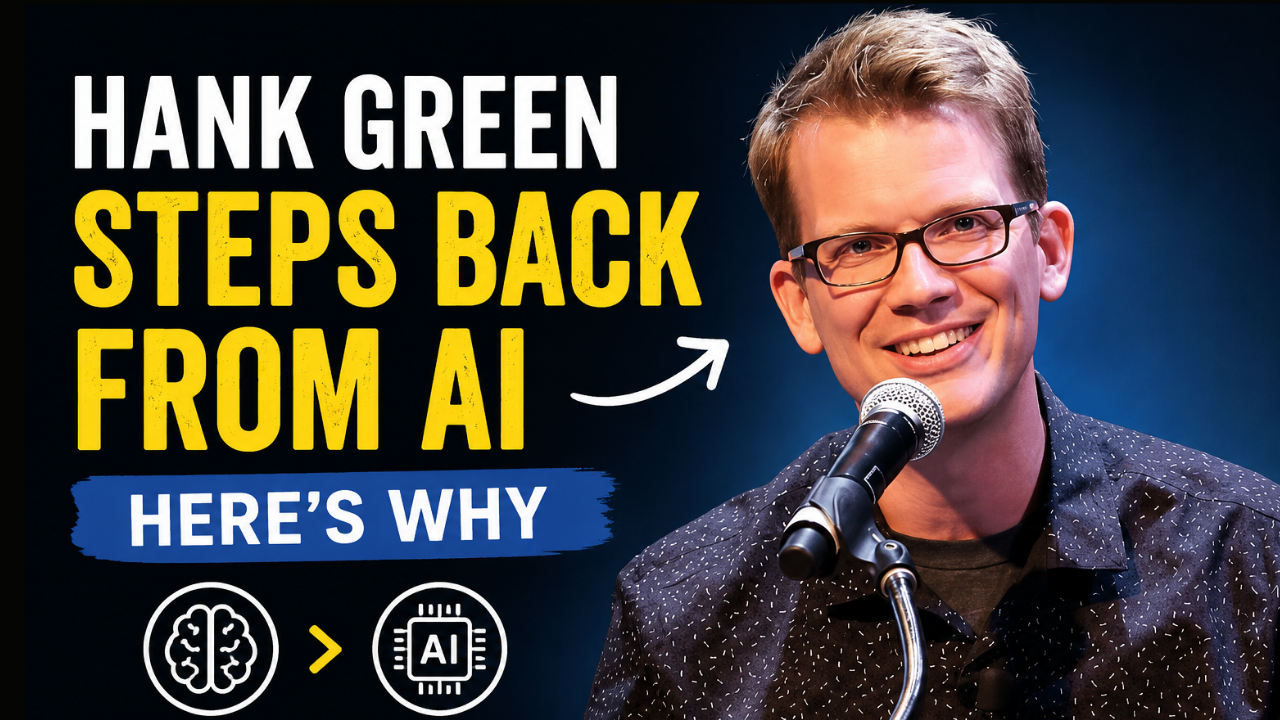
Popular science creator Hank Green has decided to reduce his use of AI after admitting it affected his creativity and research process. Here’s what happened, why it matters, and what creators can learn from it.
Hank Green Steps Back From AI: What Happened?
For the past few years, AI tools like ChatGPT have become a regular part of many creators’ workflows. From brainstorming ideas to summarizing research papers, AI can save hours of work.
But in August 2026, one of YouTube’s most respected educational creators, Hank Green, publicly admitted that he had become too dependent on AI. Instead of defending his workflow, he chose to slow down, apologize to his audience, and rethink how he creates content.
His decision has sparked a wider conversation about the balance between productivity and creativity in the age of AI.
Who Is Hank Green?
Hank Green is an American entrepreneur, author, educator, and YouTube creator best known for making science and educational content easy to understand.
Along with his brother, novelist John Green, he co-founded the Vlogbrothers YouTube channel and later launched educational brands like SciShow, Crash Course, and Complexly. He also co-created VidCon, one of the world’s largest conventions for online video creators.
With millions of subscribers across multiple channels, Green has built a reputation for creating well-researched, trustworthy, and engaging educational content over nearly two decades.

Why Did Fans Question His Videos?
The discussion began when some viewers noticed that a few of Hank Green’s recent videos felt different from his usual style.
Fans pointed out that parts of the scripts sounded unusually structured, and one section even appeared to resemble AI-generated prompt language. This led people to ask whether AI had been used to write the videos.
Green clarified that he was not using AI to write the final scripts, but he acknowledged that he had relied heavily on AI tools during the research process to discover academic papers, organize information, and speed up idea generation.
Hank Green Admitted He Relied Too Much on AI
In a detailed Reddit post published at the end of July 2026, Green explained that AI had gradually become a bigger part of his workflow than he had intended.
He said the technology was extremely useful for quickly finding research papers and gathering information. However, over time, it also changed the way he explored new topics.
Instead of slowly reading, comparing sources, and following unexpected discoveries, AI often presented information in a structured path. Green realized that this process reduced the natural curiosity that had always shaped his work.
The Productivity Trap of AI
One of the most honest parts of Green’s statement was his description of what he called the productivity trap.
Because AI helped him complete research much faster, he felt encouraged to produce more videos, more ideas, and more projects.
Eventually, he realized he was spending more time interacting with AI than with the original books, research papers, and sources that inspired his work.
According to Green, this constant drive to create more wasn’t making him happier—it was making him feel disconnected from the creative process that originally motivated him.
AI Didn’t Replace His Voice—But It Changed His Process
Green repeatedly emphasized that the opinions in his videos were still his own.
However, he admitted that relying on AI for research influenced how he reached those ideas.
Traditional research often leads creators through unexpected articles, different viewpoints, and surprising discoveries. AI, on the other hand, tends to summarize information into a more direct path.
Green believes that skipping those slower moments of exploration made his content feel less personal and less authentic.
Why Hank Green Is Slowing Down
Rather than ignoring criticism, Green chose to make significant changes.
He announced that he would:
- Publish fewer videos for the time being.
- Pause some AI-assisted projects.
- Rebuild a more human-centered research process.
- Be more transparent about how AI is used in future work.
He also apologized to his audience, saying he never wanted technology to dilute the trust people had placed in his content.
What This Means for Content Creators
Hank Green’s experience isn’t an argument against AI.
Instead, it highlights an important lesson: AI works best as an assistant—not as a replacement for curiosity.
For creators, AI can be incredibly useful for tasks like:
- Finding research papers
- Organizing information
- Brainstorming ideas
- Summarizing long documents
- Improving workflow efficiency
But creativity still comes from asking questions, exploring different viewpoints, verifying facts, and developing original insights.
When AI becomes the entire process instead of one tool within it, creators may lose the unique perspective that makes their work valuable.
The Bigger Conversation Around AI and Creativity
Green’s story reflects a challenge many writers, educators, developers, and creators are beginning to discuss.
AI can dramatically increase productivity, but speed isn’t always the same as quality.
Researchers and technology experts have also raised concerns that relying too heavily on AI may reduce opportunities for independent thinking, careful analysis, and deep learning over time.
Finding the right balance between automation and human creativity is becoming one of the most important questions in the creator economy.
Final Thoughts
Hank Green’s decision to reduce his reliance on AI wasn’t driven by a technical failure—it was driven by a creative one.
He realized that while AI helped him produce content faster, it also changed the way he researched, learned, and connected with ideas. By choosing to slow down, Green reminded creators that authenticity often comes from the journey of discovering information, not just the speed of delivering it.
As AI continues to evolve, his experience serves as a valuable reminder that technology should enhance human creativity—not replace the curiosity, critical thinking, and personal perspective that audiences trust most.