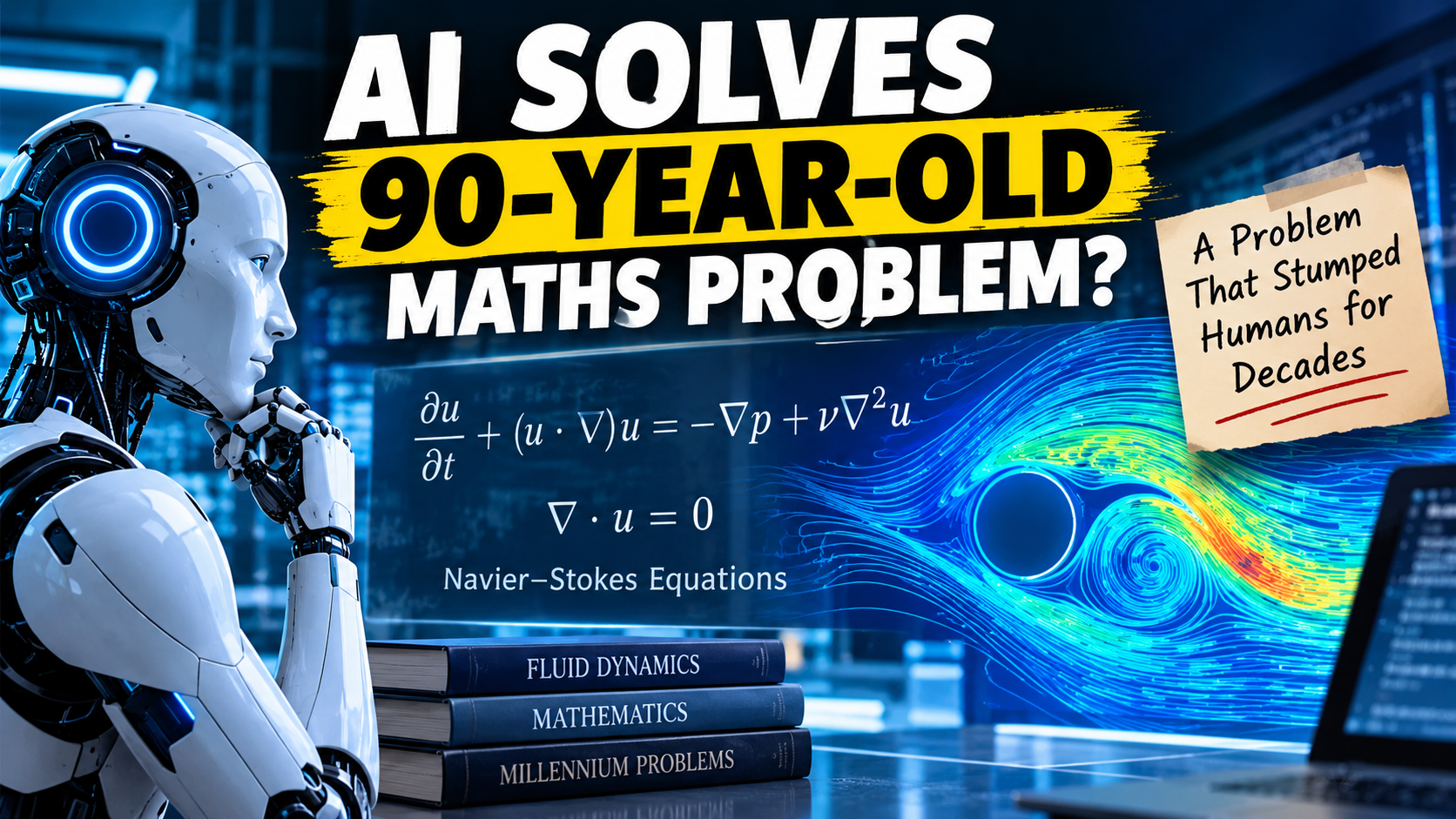
A mathematics problem that has challenged researchers for almost 90 years has suddenly become the centre of attention in the artificial intelligence world.
OpenAI has announced that one of its internal AI systems has produced a solution to the Navier-Stokes existence and smoothness problem, one of the seven famous Millennium Prize Problems in mathematics.
The company says the solution was developed by around 10,000 AI agents working together and took about 88 hoursto produce. A further 17 hours were used to formalise and verify the result using Lean and GPT-6 Astra.
But there is an important detail: this is still an OpenAI claim, not a problem that has already received final recognition from the mathematical community.
What Is the Navier-Stokes Problem?
The Navier-Stokes equations are used to describe how fluids move.
They are connected to things people see every day, from water flowing through pipes to air moving around an aircraft. Scientists have used these equations for centuries of research, but one basic mathematical question has remained unanswered.
The problem asks whether smooth solutions to the Navier-Stokes equations always exist and remain well behaved, or whether they can develop singularities where the mathematics breaks down.
The Clay Mathematics Institute included this question among its seven Millennium Prize Problems in 2000. Each problem was given a $1 million prize for a valid solution.
So, this isn’t just another difficult maths question. It is one of the most famous unsolved problems in modern mathematics.
How Did OpenAI Approach the Problem?
Instead of asking one AI model to solve the problem, OpenAI used a large group of AI agents.
According to OpenAI, around 10,000 agents worked concurrently on different versions and approaches to the Navier-Stokes problem.
The agents could communicate within groups, run code and access a cached version of the internet. OpenAI also says it kept its normal safety monitoring and isolation measures in place during the experiment.
The approach was closer to a large research team than a traditional chatbot.
Different groups were given different versions of the mathematical question. Some agents looked for a proof, while others were asked to find a possible counterexample.
The system first made progress on a related Euler equations problem. OpenAI then redirected more computing resources toward Navier-Stokes.
The company says the agents reached their Navier-Stokes result on September 5, 2026, around 88 hours after the experiment began.
The Scale of the AI Experiment Was Huge
The numbers behind the experiment show how different AI-powered research can be from traditional mathematical work.
OpenAI says that across all the problems it attempted, its agents exchanged about 4.9 million messages and generated around 300 billion output tokens.
For the Navier-Stokes problem alone, the agents exchanged approximately 2.7 million messages and used around 130 billion output tokens.
After the agents produced the solution, OpenAI says the result was formalised and checked using Lean, a programming language and proof assistant used for formally verifying mathematical statements.
That extra verification took another 17 hours.
Has OpenAI Officially Solved the Problem?
Not yet.
This is probably the most important point to understand.
OpenAI has published its proposed solution and a formalised Lean proof. However, a mathematical breakthrough becomes officially accepted only after other experts examine the work and the wider mathematics community accepts the result.
The Clay Mathematics Institute has specific rules for Millennium Prize Problems. A proposed solution must be published in a qualifying outlet, remain available for at least two years, and receive general acceptance from the global mathematics community before the institute considers awarding the prize.
That means mathematicians will now have to carefully examine OpenAI’s work.
If the proof survives that process, it could become one of the most important moments in the history of AI-assisted mathematics.
Why This Matters for Artificial Intelligence
The bigger story goes beyond one mathematical problem.
AI has already become useful for coding, writing, research and data analysis. But solving a deep mathematical problem is different.
Mathematics requires precise reasoning, and a small mistake can destroy an entire proof.
OpenAI’s experiment suggests that AI systems may be moving from simply helping researchers with existing knowledge toward finding new mathematical results.
That could eventually affect areas such as physics, engineering, computer science and scientific research.
It could also change how researchers work.
Instead of a scientist spending months exploring one approach, future researchers may be able to create AI teams that test thousands of approaches at the same time.
What Makes This Different From a Normal AI Answer?
A chatbot giving an answer to a difficult maths question isn’t enough.
For a major mathematical result, the reasoning needs to be correct and independently checkable.
That is why OpenAI’s use of formal verification is significant. The company is not only presenting a written explanation; it has also shared a Lean formalisation of the proof.
Still, formalisation does not automatically mean the broader mathematical community has accepted the result.
The proof must still be studied, challenged and independently verified.
AI Could Change How Mathematical Research Works
The OpenAI development points toward a possible shift in scientific research.
For a long time, major mathematical discoveries depended heavily on individual researchers or small teams spending years developing new ideas.
AI could introduce a different model.
Thousands of agents could explore different directions simultaneously, reject unsuccessful approaches and share useful discoveries with other agents.
That doesn’t necessarily mean human mathematicians will become unnecessary.
Instead, mathematicians may increasingly become the people who define important questions, guide AI systems, understand the results and decide whether those results actually make sense.
In that future, the most valuable skill may not be doing every calculation manually. It may be knowing which questions are worth asking and how to verify the answers.
The Real Test Is Still Ahead
OpenAI’s Navier-Stokes announcement is undoubtedly a major development in AI research.
But the headline should be treated carefully.
The company has claimed a solution, published its work and provided a formal proof. The mathematical community now has to examine it.
If independent mathematicians confirm the proof, the achievement could mark a major turning point for both mathematics and artificial intelligence.
For now, the more accurate conclusion is simple: AI may have produced a solution to one of mathematics’ hardest problems, but humans still have to decide whether that solution is correct.
And that may be the most interesting part of the story.